Venting beats Cabin Overheat Protection. Tesla just won't do it for you.
Cracking the windows is the more effective way to cool a parked Tesla, and it costs no battery. Cabin Overheat Protection spends real range doing a worse job. Tesla makes venting a manual, one-tap action instead of an automatic setting, most likely for liability reasons. That gap is exactly what VentMode closes.
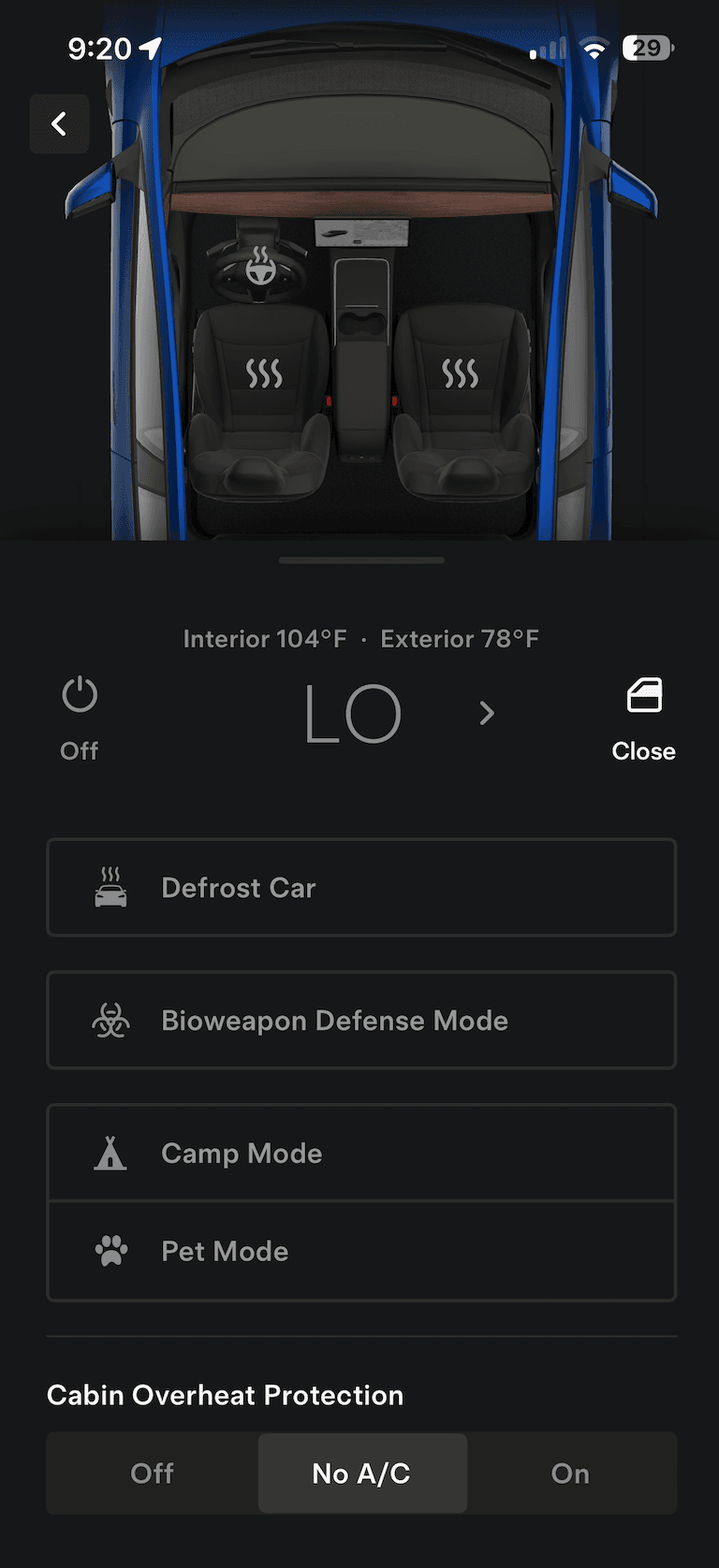
The only automatic option Tesla ships is Cabin Overheat Protection, which runs the A/C. Venting stays a manual, one-tap action in the app.
Venting wins on effectiveness, not just on cost
A parked car overheats because of the greenhouse effect: sunlight comes in through the glass, turns into heat at the seats and dashboard, and that heat can't get back out through the same glass it came in through. Cracking the windows a few inches breaks that trap directly. It gives the superheated air a path out and lets outside air replace it, which is why venting is the single most effective lever you have on the actual cause of the heat, not just a workaround for its symptoms.
Cabin Overheat Protection doesn't touch the trap at all. It leaves the windows sealed, so the heat keeps building the same way it always would, and then fights that buildup by running the air conditioning to pull the temperature back down. That's treating the symptom with active cooling instead of removing the cause. Venting is structurally the better method: it stops the problem from occurring, rather than continuously correcting for a problem it's letting happen.
One of these costs battery. The other costs nothing.
Cabin Overheat Protection holds your cabin below a threshold (105°F by default) by running the HVAC compressor for as long as conditions demand it. That's a real, continuous draw on your battery for the entire time your car sits in the heat, which on a long hot afternoon is hours, not minutes. Tesla is intentionally vague about the exact kWh cost because it depends on ambient temperature and how hard the compressor has to work, but the honest framing is simple: it's spending stored energy the whole time it runs.
Venting costs none of that. Air moving through a cracked window costs zero battery whether it runs for ten minutes or ten hours. You're not paying an ongoing energy bill to fight the heat, you're just letting it leave. If your goal is to protect range while also protecting the cabin, venting is not a close call.
Tesla makes the better option the manual one
Here's the part that doesn't get said enough: Tesla's app lets you vent the windows, but only as something you tap yourself, in the moment, from your phone. There is no setting anywhere in the car or the app that watches the weather and cracks the windows automatically the way Cabin Overheat Protection automatically runs the A/C. The more effective, lower-cost method is the one you have to remember to do by hand; the less effective, battery-draining method is the one Tesla ships as a background toggle you flip once.
That's most likely a liability decision, not an oversight. An automated system that runs the air conditioning inside a sealed, locked car is a contained, predictable action. An automated system that opens a car's windows while nobody's around introduces a different risk profile: weather changing faster than expected, security assumptions people make about a 'closed' car, edge cases Tesla would rather not own as a mass-market default. It's a reasonable thing for a car manufacturer to be cautious about. It also means the more effective, cheaper option was left on the table as something only a third party would build.
That gap is exactly what VentMode is
VentMode automates the option Tesla left manual. It watches the weather at your car's actual location, and when it's hot and dry during the day it vents the windows the same few inches you'd do by hand, then closes them before evening or the moment rain shows up in the current conditions or the 3-hour forecast. You get the effective, no-battery-cost method, running automatically, with the one thing Tesla's own manual venting doesn't have on its own: a rain check and a guaranteed evening close so windows never sit open into a storm or overnight.
You can still use Cabin Overheat Protection on days you want the cabin genuinely cold the moment you get in and don't mind spending the range for it; the two aren't mutually exclusive. But as a default, day-to-day answer to 'how do I stop my car from cooking,' venting wins on physics and on cost. VentMode's whole reason to exist is turning that win into something that runs by itself instead of something you have to remember.